Galactic Bulge Survey Pipelines
MSOS will produce Level-3 and Level-4 data products for the Nancy Grace Roman Space Telescope Exoplanet Microlensing Survey (EML) out of calibrated Level-2 data products.
Microlensing Science Operations System (MSOS)
Roman Exoplanet Microlensing Investigation
The high-level science goal of the Roman Exoplanet Microlensing Investigation is to utilize the gravitational microlensing technique to produce a statistical census of exoplanetary systems, with focus on planets from the outer habitable zone to free floating planets, including analogs of all the planets in our Solar System with masses greater than that of Mars. Here we summarize the properties of the survey specified in the Roman Observations Time Allocation Committee (ROTAC) Final Report as needed to understand the structure of the MSOS processing.
The survey will cover five fields in the Galactic Bulge and one field in the Galactic Center, observed over six seasons distributed across the five years of the Roman prime mission. Each season will consist of nearly continuous observations for ~70 days each during the Roman visibility window towards the Galactic Bulge (around the spring and fall equinox). Observations of each field will be taken every 12 minutes with the wide band filter and every 6 hours with each of two additional filters. The science requirements are based on the above survey monitoring ~240 million star-years with an expected star density down to J=23 of ~ few hundred million stars per square degree.
Pipeline Processing and Data Products
The MSOS pipeline takes as input Level 2 calibrated data, creates a catalog of objects, and measures the astrometry and photometry for each of those objects for each epoch of the survey (nominally every 12 minutes), along with additional ancillary products. The second stage of the MSOS identifies and analyzes microlensing events, including planetary events, using MSOS photometry products as input. Finally, the MSOS will also quantify the pipeline detection efficiency, using simulated data. Figure 5 shows a schematic of the MSOS components.
The MSOS pipeline will have three modes: daily, end-of-season, and end-of-survey. The three timeline modes reflect the cadence of the GBTDS and the corresponding plan to deliver the science data products to the Roman archive. All MSOS products will be delivered to SOC and subsequently hosted in the Roman archive at MAST. Each mode and its resulting products are described in more detail below. The MSOS pipeline will run and generate data products in an automated mode. The pipeline source code will be made available.
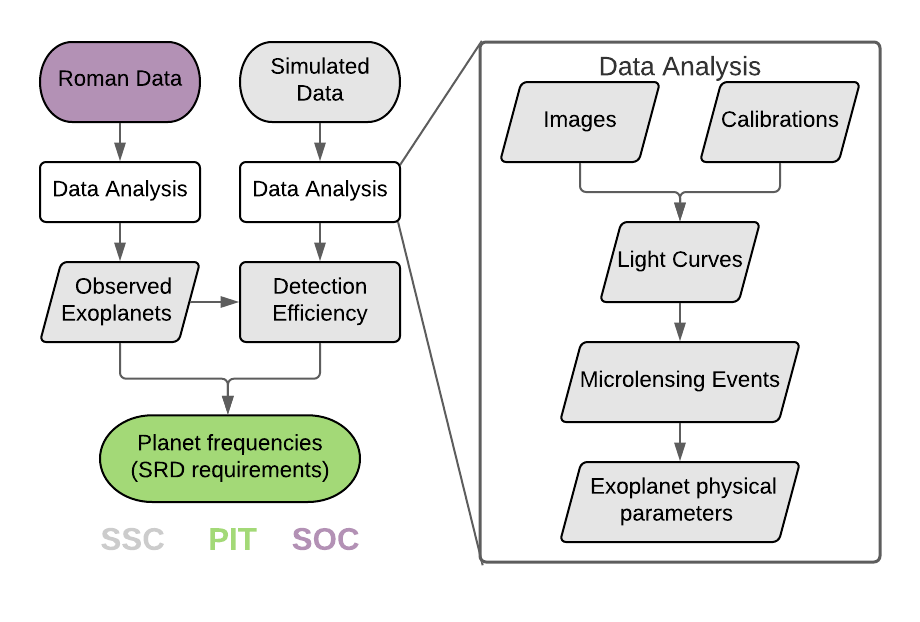
High-level processing diagram for the MSOS pipeline.
MSOS Pipeline Temporal Modes

The overview of the temporal modes of MSOS pipeline.
First 30 days
During the first 30 days of the first season, the daily pipeline will not operate, as the necessary catalog data will not be available. The initial point spread function (PSF) models will be in part based upon high-fidelity models of the optics and in part of upon detector models developed during the Commissioning Phase. The data reduction plan for the first 30 days is:
- Create a super-sampled reference image using data from every 8 days
- Establish preliminary PSF models
- Use PSF fitting on the reference images to create the object catalog of known targets.
The SSC will not deliver data products to the SOC during the first 30 days of the first microlensing survey season. Once the above steps are complete, the SSC will process the first 30 days of data following the daily pipeline mode.
Daily Pipeline
The science goal of the daily pipeline is to provide well-calibrated data products during each GBTDS season for all the detected objects in the GBTDS. It will run every day during the GBTDS observing season. The archival products produced will be returned to the SOC within 48 hours.
To preserve the critical temporal information in the microlensing survey, the daily pipeline will start with the Level 2 calibrated data from SOC. The daily pipeline runs the Photometry pipeline, with the following high-level steps. More details on the Photometry pipeline are below.
- Update the PSF model
- Run PSF fitting on the stars in the current object catalog
- Update light curves with results of PSF and DIA (difference imaging analysis)
- Produce data quality metrics
- Return data to the archive
Creating the Reference Images
After every roughly 7 to 8 days the MSOS will execute the following steps, in addition to the daily steps:
- Create new super-sampled reference image
- Update the object catalog
- Return data to the archive
The data products created by the MSOS daily pipeline for each identified source include: flux, position, PSF fit shape measurements, and quality flags. The MSOS will deliver Level 3 and Level 4 products of the daily pipeline to the SOC within 2 days of receipt of the last input data needed for those products.
End-of-Season Pipeline
At the end of each GBTDS observing season, the final reference image will be used to generate the list of new sources to be added to the object catalog. Then the daily pipeline will be run again to produce all the products from the daily pipeline in both the regular and 8-day modes. The Photometry pipeline will be re-run on applicable previous seasons when substantial improvements due to parallactic motion are made in the source positions and proper motions.
In addition, the SSC will run the Events pipeline (see details below) which identifies and characterizes variable objects and performs modeling for microlensing candidates. The additional data products produced by this mode are the variability catalog, and a catalog of microlensing events with model fits and physical parameters. These data products will be sent to the SOC for inclusion in the Roman Archive. The SSC will deliver Level 3 and Level 4 data products of the end-of-season pipeline to the SOC within 6 months of receipt of the last input data needed for those products.
End-of-Survey Pipeline
At the end of the GBTDS survey, a final run of the pipeline will run on the complete data set to produce all products from the end-of-season pipeline, and will complete within 6 months after receiving the relevant data products from the SOC. In addition to the end-of-season products, the following data products are also produced by the MSOS pipeline at SSC:
- Relative source-lens proper motion for all identified microlensing events.
- Distance parallax for all the catalogued sources.
The MSOS shall deliver Level 3 and Level 4 data products of the end-of-survey pipeline to the SOC within 6 months of receipt of the last input data needed for those products.
Summary of Data Products
The table below summarizes the data products produced and the cadence on which they are reprocessed. Note that the reddening and extinction maps are used by the pipelines, but are not generated from Roman data.
| Product Name | Description | Data Level | Data volume (daily or 8-days) | Data volume (season) | Data volume (survey) | Delivery Format | Daily | 8-days | End-of-season | End-of-survey | Between seasons |
| Wide-band Reference Frame | Supersampled images per tile from the wide-band filter. Used to generate fiducal catalog. | 3 | 3.3TB | 33 TB | 200 TB | ASDF | N | Y | Y | Y | N |
| Other filters Reference Frame | Supersampled images per tile from the other filters. Sampling will depend on observation cadence | 3 | N/A | 8.5 GB | 51 GB | ASDF | N | N | Y | Y | N |
| Fiducial catalog | Reference data for all objects detected | 4 | 40 GB | 40 GB | 40 GB | parquet | N | Y | Y | Y | N |
| Periodic catalog | Based on reference frame frequency | 4 | 40 GB | 400 GB | 2.4 TB | parquet | N | Y | Y | Y | Y |
| Lightcurve catalog | Per epoch measurements | 4 | 3 TB | 210 TB | 1.3 PB | parquet | Y | Y | Y | Y | Y |
| Photometry DQA | Data Quality Assessments | 4 | 30 MB | 200 MB | 1 GB | Y | N | Y | Y | Y | |
| Variability catalogs | Catalog that contains a listing of candidate variable objects | 4 | N/A | 32 GB | 32 GB | parquet | N | N | Y | Y | N |
| Event catalog | List of candidate microlensing events, including physical and event parameters | 4 | N/A | 240 MB | 240 MB | parquet | N | N | Y | Y | N |
| MCMC chains | Results of Markov Chain Monte Carlo | 4 | N/A | 3 TB | 3 TB | NetCDF | N | N | Y | Y | N |
| Event DQA | Data Quality Assessment for the Events Pipeline | 4 | N/A | 10 MB | 30 MB | ||||||
| Reddening and Extinction Maps | Record of what reddening was used for physical parameter determination | 4 | N/A | 10 GB | 10 GB | ASDF | N | N | Y | Y | N |
| Detection Efficiency Table | Image and light curve injection parameters and binary classification (FP/FN rates). Rhie method parameters and chi2s. | 4 | N/A | N/A | 150 GB | parquet | N | N | N | Y | N |