MSOS Detection Efficiency Pipeline
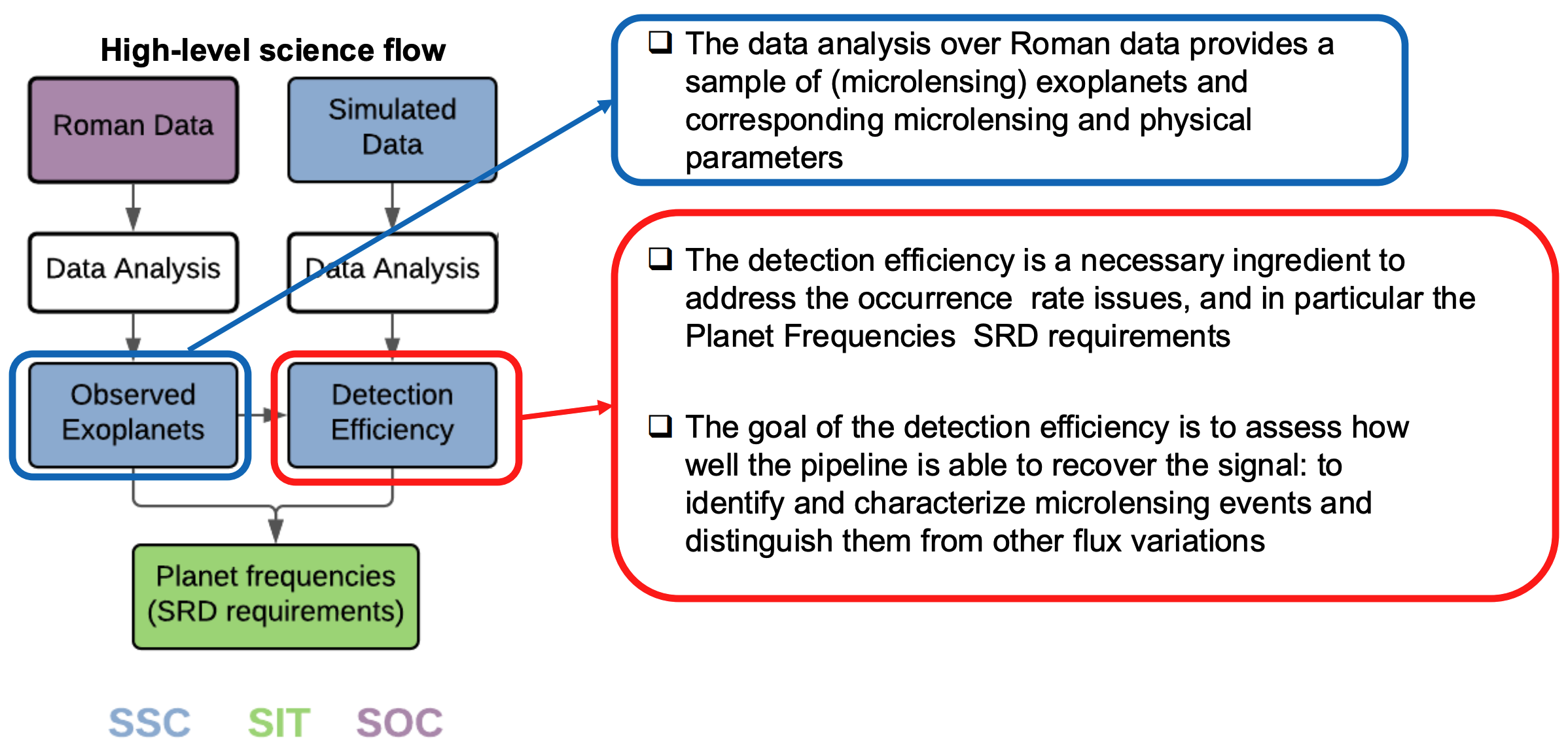
The Microlensing Science Operations System (MSOS) pipeline for the image analysis and the subsequent identification and characterization of microlensing events, in particular of planetary events, is completely automated. This allows an attempt to evaluate the completeness (false negative rate or FN rate) and reliability (false positive rate or FP rate) of the pipeline itself. This evaluation is the purpose of this component.
Detection Efficiency Pipeline Overview
Image and Lightcurve Injection
Microlensing events are injected into L2 images or into light curves and processed through the MSOS photometry and modeling pipelines. The output of the pipeline is compared with the input and the FP/FN rates are recorded. All input and output properties are saved into a catalog for the community to access.
The analysis is carried out over a fine grid of (s,q) values and for each over a sequence of values for the angle of the lens-source trajectory over which the results are marginalized. In addition, the analysis is repeated over a series of value of the finite size parameter, ρ. The resulting data product is a catalog of all input parameters and output classification and model so that the average detection probability P(s,q) can be derived.
The analysis is carried out over the ensemble of all detected microlensing events searched for planetary signals recorded in the MSOS Microlensing Catalog.
The analysis makes uses of the MSOS component to evaluate the microlensing binary magnification model.
For each event the following MSOS data products are used:
- Light Curve catalog: id, epoch, flux and error on the flux, data flag.
- Microlensing Catalog: microlensing parameters for the single model (t0,u0,tE), ρ (contingent to the model, otherwise to be sampled based upon the source angular radius, θ*, and relative proper motion, μrel); source and blend flux parameters, fs and fb.
Detection Efficiency Pipeline Flow
Rhie Method Analysis
A catalog containing all input and output parameters of the Rhie method analysis will be provided to the community after the end of the GBTDS Survey.
- Rationale of the method
- Assess whether a given (binary) planetary model can be detected from the data
- Input products
- Light Curve Catalog
- Microlensing Catalog (the ensemble of detected events searched for exoplanets)
- Astrophysical prior (grid of values to be tested for binary microlensing magnification model)
- Output products
- Catalog of all input parameters and output including chi2.
- Detection Efficiency as a function of the binary microlensing parameters (q, 𝑠): per microlensing event and average
- Detection Efficiency as a function of planet mass and separation (physical units): per microlensing event and average
- Procedure
- Catalog-level injection of a simulated binary lens model (with the underlying single-lens model parameters as in observed events), provided a noise model
- Single lens model least square minimization to assess whether the planet can be detected
- Efficiency is the fraction of detected events after marginalization over non-essential parameters
- Efficiency in physical parameter space based upon prior on lens mass and distance
- Key parameters
- Grid in the binary microlensing space and for finite source effect
- Threshold ∆𝜒2 for detection