MSOS Photometry Pipelines
The MSOS Photometry Pipeline will generate three distinct types of catalogs: Fiducial, Periodic, and Light Curve catalogs. Brief descriptions of each are provided below. The accompanying diagrams illustrate key components and functions of the Photometry pipeline.
MSOS Photometry Catalogs
The MSOS Photometry Pipeline will generate three distinct types of catalogs: Fiducial, Periodic, and Light Curve catalogs. Brief descriptions of each are provided below. The accompanying diagrams illustrate key components and functions of the Photometry pipeline.
- Fiducial Catalog Master catalog containing all detected objects, with reference positions standardized to a common epoch. Provides aggregate positional and photometric properties for each object and serves as the basis for cross-object comparisons. Updated periodically using data from the corresponding Periodic Catalog.
- Periodic Catalog Catalog containing per-object measurements based on approximately a week worth of data. Derived from reference frame information constructed over each period, and used to monitor changes in position and brightness. Averaging is applied to achieve sufficient signal-to-noise for reliable measurements.
- Lightcurve Catalog Catalog of individual, unaveraged photometric measurements. Enables reconstruction of object light curves and analysis of variability on short timescales.

This process detects and characterizes point sources on a reference frame using an iterative ePSF-based model. Key steps include subtracting residuals, identifying new objects, and updating the photometry solution.
MSOS Photometry Flow
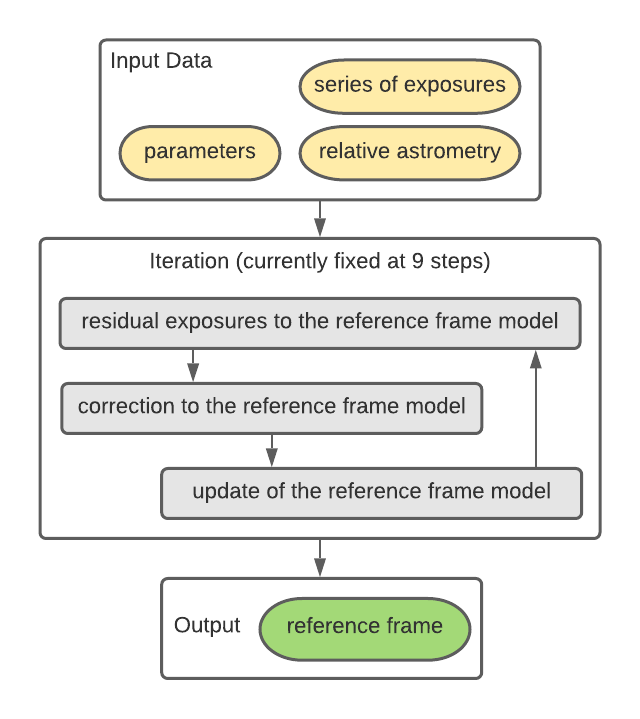
The reference frame is constructed by robustly averaging corresponding pixels from a series of dithered images with known relative astrometry, using a rescale factor of 8 to combine approximately 12 images per pixel.
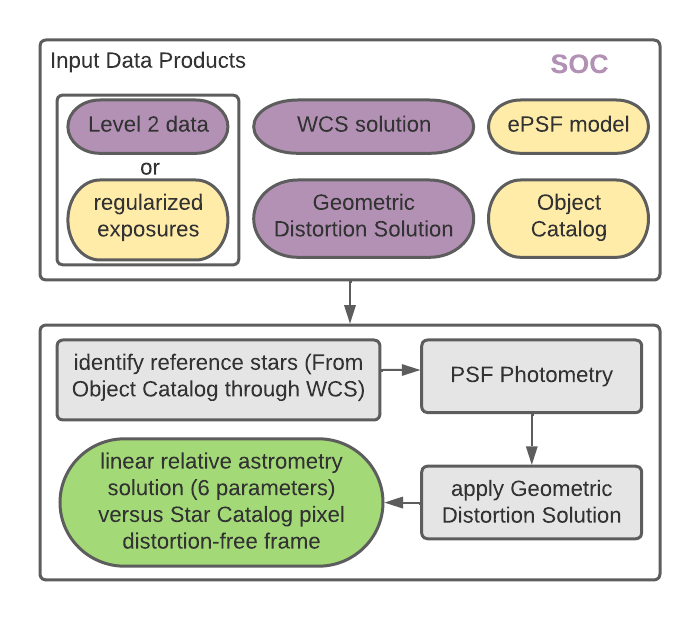
Relative astrometry solves for transformations between exposures and a distortion-free reference frame using ePSF-based fits and geometric distortion corrections, enabling six-parameter solutions based on reference stars from the Object Catalog.